Is DIY Lawn Care Really Cheaper Than a Pro?
Is mowing your own lawn really cheaper? We break down equipment, fuel, repairs, your time value, and real numbers for 1–3 acre yards so you can decide with confidence.
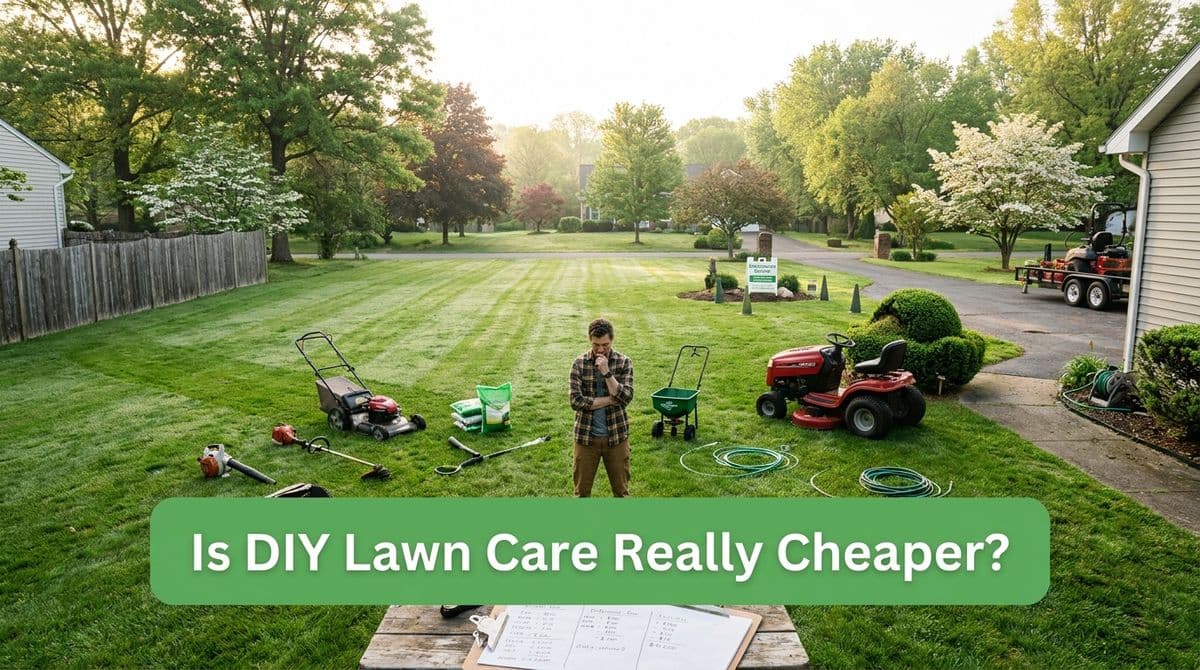
Is DIY Lawn Care Really Cheaper?
We recently got a call from a homeowner — let’s call her Jane — who had just bought a property with almost four acres right next to a local golf course. She’s got about three acres of grass, an older riding mower that finally gave up the ghost, and a to-do list a mile long for grading, yard repairs, and landscaping.
Jane told me, “I can do a lot of this myself, but every hour I’m mowing is an hour I’m not working on my own business. I just want to know: is mowing my own yard actually saving me money, or am I just babysitting a broken mower for free?”
I hear that question a lot. And honestly, my answer usually surprises people: you almost never save real money mowing your own lawn unless you genuinely enjoy it and your yard is on the smaller side. Let me walk you through the math we talked through with Jane so you can run the numbers for your own property.
The Real Costs of DIY Mowing (Beyond Just the Mower)
When folks think DIY, they picture a one-time mower purchase and “free” weekends. In reality, here’s what you’re actually paying for when you mow your own yard:
- Mower purchase (riding mower or zero-turn)
- Repairs & breakdowns (belts, blades, batteries, engines)
- Fuel (and the gas you spill in the garage)
- Routine maintenance (oil changes, filters, sharpening)
- Trimmer/weed-eater and blower costs
- Your time (this one’s huge and usually ignored)
On that call, I told Jane a story I’d just shared with one of my own crew. He bought a used mower online for about $2,200 and then had to put roughly $600 into repairs right away. That’s $2,800 before he cut a single blade of grass. When you add up what homeowners actually spend and spread it out over a few years, the “cheap DIY” story starts to fall apart.
What Are Your Hours Really Worth?
Here’s the mindset shift: every time you mow, you’re paying yourself your hourly rate to be your own lawn guy. If you make $30/hour at your job or business, that’s what your time is worth — whether you’re on the clock or behind a mower.
For example, if it takes you two hours to mow and another hour to weed-eat, that’s three hours. At $30/hour, you just “paid yourself” $90 to mow your lawn. Now add fuel, maintenance, and a slice of your mower cost, and the total gets close to — or more than — what a professional would charge.
Example: True Cost for a 1-Acre Yard
Let’s run some simple, realistic numbers for a typical 1-acre yard:
- Mower cost: $4,000 (a common price for a decent residential zero-turn)
- Useful life: 4 years of regular use
- Annual mower cost: $4,000 ÷ 4 = $1,000/year
- Fuel & maintenance: about $300/year (conservative)
- Total hard costs: $1,300/year
Now, time:
- Mow + trim time: about 1.5–2 hours per week for 30 weeks
- Let’s call it 1.5 hours × 30 = 45 hours/season
- Your time value: $30/hour × 45 = $1,350/year
Total DIY cost for 1 acre:
- Hard costs: $1,300
- Time cost: $1,350
- DIY total: $2,650 per year
Now compare that to hiring a pro at, say, $75 per week for that same 1-acre yard:
- $75 × 30 weeks = $2,250 per year
So you’re paying roughly the same or even a bit more to do it yourself — and that’s before breakdowns, unexpected repairs, or those “I’ll weed-eat next week” corners that never quite look finished.
Example: True Cost for a 3-Acre Property
This is where it really hits home for folks like Jane with 3+ acres.
- Mower cost: $6,000 (heavier-duty mower for bigger acreage)
- Useful life: 4 years
- Annual mower cost: $6,000 ÷ 4 = $1,500/year
- Fuel & maintenance: around $500/year
- Total hard costs: $2,000/year
Time commitment (this matches what we see all the time):
- Mowing: about 2–2.5 hours per week
- Weed-eating: often skipped weekly, then 3+ hours every few weeks
- Realistically, you average around 3 hours per week over the season
- 3 hours × 30 weeks = 90 hours/season
- Your time value: $30/hour × 90 = $2,700/year
Total DIY cost for 3 acres:
- Hard costs: $2,000
- Time cost: $2,700
- DIY total: $4,700 per year
We can usually mow and trim a clean 3-acre property in well under an hour with commercial equipment and a small crew. At, say, $150 per week for 30 weeks, that’s:
- $150 × 30 = $4,500 per year
Again, you’re right in the same ballpark, except a pro is in and out quickly and the lawn looks like it’s supposed to — every time.
When DIY Makes Sense
I’m not here to convince everyone to outsource everything. There are times when mowing your own lawn absolutely makes sense:
- You enjoy it. Some people genuinely like that hour on the mower as “therapy.” That’s worth something.
- Your yard is small. For a small city lot, a push mower and 30–45 minutes of your time can still be cost-effective.
- You already own the equipment. If your mower is paid off, in good shape, and you’re handy with maintenance, your hard costs drop.
- You’re flexible on appearance. If you’re okay with the lawn not being “builder-showcase perfect” every week, DIY can work fine.
If mowing genuinely relaxes you and your yard isn’t huge, then the “time cost” is more like a hobby expense than a business decision — and that’s okay.
When Hiring a Pro Is the Smarter Play
On the other hand, there’s a very clear point where your lawn stops being a hobby and starts being a second job:
- Anything over 1–1.5 acres starts to eat big chunks of your weekend.
- You have a demanding job or business. If you can earn $100–$300+ an hour doing what you’re good at, trading that time for mowing rarely makes sense.
- Your mower is aging or unreliable. Constant breakdowns destroy both your schedule and your budget.
- You’re behind on other property projects. Grading, drainage, landscaping, tree work — all the “bigger picture” items keep getting kicked down the road.
That was exactly Jane’s situation. She said, “If we try to do all of this ourselves, it’s going to take five years. Or we can phase it, spend the money wisely, and have the property where we want it in a year or so.” That’s the right way to think about it.
Phasing Big Projects: How to Win Back Years of Your Life
One of the best strategies for larger properties is to phase out the big projects instead of trying to DIY everything forever. Here’s how we often structure it:
- Phase 1: Grading & drainage. Fix low spots, standing water, and rough areas. A skid steer and an experienced operator can do in a few days what might take you years with a shovel and a borrowed tractor.
- Phase 2: Yard repairs and seeding. Level ruts, repair bare areas, overseed, and establish a healthy, uniform lawn that’s easier and faster to maintain.
- Phase 3: Landscaping & tree work. Beds, edging, tree removal or trimming, plantings — all the things that add curb appeal and reduce long-term headaches.
- Phase 4: Ongoing mowing and lawn care. Once the heavy lifting is done, weekly mowing, fertilization, and weed control keep everything looking sharp.
By outsourcing the heavy equipment work and the weekly mowing, homeowners like Jane can focus on what they do best, enjoy their property sooner, and avoid five years of “weekend warrior” burnout.
Running the Numbers on Your Own Yard
If you’re on the fence, here’s a simple way to decide:
- Write down your hourly earning potential (what you realistically make or could make per hour).
- Estimate your weekly mowing + weed-eating time.
- Multiply those hours by your hourly rate for the season (roughly 30 weeks).
- Add your annualized mower cost (purchase price ÷ years) plus fuel and maintenance.
- Compare that total to a few quotes from reputable lawn pros.
If the numbers are close, ask yourself one more question: Do I actually want to spend this much of my life mowing? If the answer is no, it might be time to hire a pro and start enjoying your yard instead of working for it every weekend.